Showing posts with label LTC. Show all posts

Friday, June 13, 2014

TMC Reacts ON LTC Scam

LTC scam: CBI books cases against MPs  -Hindu Business Line
New Delhi, June 13:  
The Trinamool Congress on Friday accused the Union Government of using the CBI for “political vendetta” after the agency booked one of its parliamentarians among six sitting and former Rajya Sabha MPs for reimbursement through forged bills.
 
The CBI has filed an FIR against three sitting and three former MPs in what has come to be termed the Fake LTC (Leave Travel Concession) scam. Brajesh Pathak of the BSP, D Bandhopadhyay of the TMC and Lalhming Liana of the Mizo National Front are the three sitting MPs named in the FIR.
 
The FIR also mentions three former MPs — JPN Singh of the BJP, Mahmood A Madani of the Rashtriya Lok Dal and Renu Bala Pradhan of the BJD. CBI officials said searches are on at 10 different locations in Delhi and Odisha. These include the premises of persons named in the FIR as well as some travel agents.
 
Fake boarding passes

The FIR says the MPs claimed full payment on companion air tickets from the Rajya Sabha Secretariat using fake e-tickets for travelling by Air India flight.
 
Sources said the CBI found some more instances of alleged criminality when documents recovered during the first case registered in this connection on November 1 last year were scrutinised. In the first FIR in the LTC scam, the CBI booked JD(U) Rajya Sabha MP Anil Kumar Sahani for allegedly drawing around ₹9.5 lakh by presenting fake air tickets and boarding passes.
 
Besides the MP, an Air India customer service agent, Rubaina Akhtar, and a Lajpat Nagar, Delhi-based travel operator, Air Cruise Travels Pvt Ltd, were also named in the FIR. The LTC claims were forged citing travel on Air India.
 
The CBI had found prima facie irregularities in the LTC claims with an intention to maximise personal benefit by scuttling the norms in collusion with travel agents. The scam came to light after Air India’s vigilance department was alerted about the arrest of a man at Kolkata airport in March 2013 with 600 blank boarding passes of the airline in his possession.
 
Leader maligned

The TMC, which is also being targeted by the BJP for alleged violence in the Lok Sabha polls, reacted sharply to veteran party leader Bandhopadhyay being “maligned” for political reasons.
“For years, the Congress government has used the CBI with a political motive. The BJP is following that sickening path,” said Trinamool parliamentarian and spokesperson Derek O’Brien.
 
“We strongly condemn this attitude of using the CBI with the motive of political vendetta against the main opposition parties. In a democratic set-up, this is just not done. We will fight this in the way we have fought our battles for the last 35 years — politically and democratically,” added O’Brien.
 

CBI Arrests 6 MPs of Rajya Sabha In LTC Scam

LTC scam: CBI books six present, former Rajya Sabha MPs-times of India -13th June 2014

NEW DELHI: The CBI on Friday registered cases against six current and former Rajya Sabha MPs in the Leave and Travel Concession (LTC) scam, an official said.

This is the first case registered by the Central Bureau of Investigation (CBI) in the scam.

According to the agency, searches are being conducted at 10 locations, which include the houses, office premises of the MPs and also at the offices of travel agencies in Delhi and Odisha.

Lakhs of rupees are said to have been fraudulently claimed from the government through fake leave travel concession (LTC) claims, availed by government officials to get concessional tickets.


The incident came to light after the vigilance department of Air India (AI) was alerted about the arrest of a man in March at the Kolkata airport with 600 blank boarding passes of the airline in his possession.


Link times of India

Lid off leave travel concession racket: Govt, PSU employees to face CBI heat-Times of India-22nd August 2013
NEW DELHI: The CBI has been called in by the Central Vigilance Commission (CVC) to investigate a widespread racket in claims of leave travel concession (LTC) involving central government and public sector employees as well as travel agents.

The CBI, which was asked on August 16 by CVC to carry out a criminal investigation, is likely to question dozens of such employees. Large sums are said to have been siphoned out of the government by producing fake Air India tickets and boarding passes (the only airline that government and PSU employees are allowed to use for LTC).

A sizeable number are of the rank of under secretary and above. Most of them claimed to have travelled with their family to the extremities of the country — the northeast, Kerala and the Andamans. The racket, said sources, has been one of the worst kept secrets although there was no actionable evidence against it.

The Kolkata Police was the first to stumble upon the LTC racket in March this year when it detained a passenger at Kolkota airport with more than 600 blank boarding passes of Air India. He was to board a SpiceJet aircraft to Port Blair. On being interrogated, he claimed that he was to deliver it to someone in the Andamans. The surmise is that this someone in the Andamans was to fill up fictitious details of flights there on the blank boarding passes. An investigation by the police is underway, sources said.


Air India's vigilance division began an investigation after the airline was asked about the fake boarding passes. Initial inquiries by the airline confirmed that it was a fairly widespread practice among government employees to manipulate LTC by submitting forged boarding pass and tickets, and hugely inflating fares.

In March, the Rajya Sabha secretariat asked Air India for verification of seven tickets issued by a travel agency to secretariat employees on the Delhi-Kolkota-Port Blair sector. Air India reported back that the tickets and boarding passes were fabricated. "No such journey has been undertaken by the seven people," Air India said.

The fictitious tickets submitted to the RS secretariat turned out to be a crude job — they included a business class ticket, even though Air India has no business class seats to Port Blair. Some of the boarding passes had the same number, even same seat numbers. And each ticket was for Rs 1.35 lakh, although the fare on that particular day was nowhere near that amount.

Air India also carried out an internal investigation into another complaint, this one from the Ordnance Factory Board. From the Board's Jabalpur plant over 400 employees and their families ostensibly travelled to the northeast to avail LTC between 2006 and 2008. Under a special order of the government to promote tourism in northeast, even the lowest ranked government employees and their families can fly to northeast sector and claim airfare under LTC.

A ticket submitted by a Jabalpur employee was found to have been valued at an incredible Rs 2.11 lakh; it's hardly surprising that it turned out to be a forgery. While the e-tickets were definitely forged, it is still not clear how on many of these tickets people actually travelled.

It is suspected that some of these tickets may have been bought by cash by travel agents from Air India. And then they may have created forged e-tickets, showing higher fares. Whatever may be the case, the CBI is expected to investigate all the 400 families that travelled to northeast from Jabalpur, sources said.

Sources also said the LTC racket appears to be rampant across government departments, public sector units, and public sector banks.

It also appears that many officials submit forged boarding passes and e-tickets of travel between Delhi and Thiruvananthapuram, while they are actually travelling to Colombo or Singapore. In other words, on the basis of their LTC claims, employees are undertaking foreign trips, which this facility doesn't allow.


Link times of India news August 2013

Tuesday, June 10, 2014

Work Culture In Banks

PM’s call to improve work culture extends to banking sector-Hindu Business Line

K RAM KUMAR


Must submit ‘action taken report’ within five days
Prime Minister Narendra Modi’s fiat to Central ministries and departments to ensure “improved work culture and work environment” has been extended to all financial sector regulators, chiefs of public sector banks, financial institutions and public sector insurance companies.
Initiate immediate action


In a communication issued on Monday to the above-mentioned entities, the Finance Ministry said they are required to initiate immediate action to improve work culture and work environment in all their offices, branches, premises or “any other spaces” in their organisation.
However, the ministry has given the regulators and financial intermediaries only five days to submit their ‘action taken report’ (by June 13), so that the Cabinet Secretary can be apprised of the action taken.
As part of this exercise, the ministry wants the workspace cleared and spruced up and filed/papers neatly stacked so that a positive work environment is created.
The financial sector regulators and financial intermediaries are required to identify forms that are in vogue and shorten them to one page.
They should also encourage online submission of information and eventually universalise it.
Decision-making


For quick turnaround in decisions, the ministry said decision-making layers should be whittled down to a maximum of four.
Calling for collaborative decision-making and frequent consultations between various verticals in an organisation, the ministry underscored that the entire organisation should work as a team, with every level being encouraged to provide inputs and value-addition.
The regulators as well as the financial intermediaries have been asked to ensure effective and timely resolution of public grievances.
In the case of financial sector regulators, the ministry wants them to identify at least 10 rules or processes and even archaic laws, which are redundant and not lead to any loss of efficiency, so that they can be repealed.

There are five financial sector regulators — Reserve Bank of India, Securities and Exchange Board of India, Insurance Regulatory and Development Authority, Pension Fund Regulatory and Development Authority, and Forward Markets Commission — in the country.

Monday, June 9, 2014

Merger Of RRBs (Regional Rural Banks)

FinMin puts amalgamation of regional rural banks on hold

At present, central govt, state govts and sponsor banks like SBI and PNB provide capital                          


     RRBs were set up in 1975, to create an alternative channel to the cooperative credit structure and ensure sufficient institutional credit for the rural and agriculture sectors

The Centre has put on hold further amalgamation of regional rural banks (RRBs), as these face challenges in meeting capital adequacy norms. It is expected the focus will now be on improving their performance and exploring a new class of investors to raise capital for these.

In a communiqué to the heads of public sector banks, the finance ministry said there was a need to tap other sources of capital for RRBs. No fresh proposal of amalgamation of RRBs should be taken up, it added.


Currently, the central and state governments and sponsor banks such as State Bank of India and Punjab National Bankprovide capital to RRBs — while the Centre provides 50 per cent, the state government provides 15 per cent and the sponsor bank 35 per cent. While Centre and sponsor banks have been infusing capital, state governments have been found wanting in providing their share.

A Bill to amend the RRB Act is being considered by the parliamentary standing committee on finance. The amendments are aimed at increasing the pool of investors to tap capital for RRBs.

A senior public sector official said now, the focus would be on improving the performance of RRBs, including their profitability. Further amalgamation on this front should happen only after examining the viability of the exercise, the official added.
As of March-end, 2011, the total number of RRBs stood at 82; this fell to 64 in March 2013 and 57 in March 2014.
National Bank for Agriculture and Rural Development (Nabard), the regulating body for rural banks, has said agricultural credit disbursement by RRBs has been short of the target. The low disbursal of farm credit by RRBs was due to amalgamation and capital adequacy limitations, as these banks had to maintain a capital adequacy ratio of at least nine per cent, it said, adding RRBs didn’t have any source of capital other than paid-up capital.

RRBs were set up in 1975, to create an alternative channel to the cooperative credit structure and ensure sufficient institutional credit for the rural and agriculture sectors.

RRBs have presence throughout the country. P Chidambaram during his first innings as finance minister under United Progressive Alliance (UPA) took steps including recapitalization, and restructuring to improve the functioning and financial health. It was also meant to attain economies of scale and ensure better managerial control.

Thursday, June 5, 2014

Revised LTC Rules For Bank Employees

LTA rules for PSU banks, financial firms-Times of India 06.06.2014

NEW DELHI: It may no more be possible for employees of public sector banks and financial institutions to travel from Jaipur to Delhi via Sao Paulo.

The government has issued a comprehensive set of guidelines for employees of public sector banks, financial and insurance companies and other regulatory bodies, significantly limiting their leave travel concession (LTC) claims. The notification was prompted by the widespread misuse of LTC/LTA facilities by government and public sector employees, exposed by TOI over the last year and now under CBI investigation.

Based on reports of misuse of LTC provisions in banks, PSUs and such institutions, as well as fraud by some government employees, the Central Vigilance Commission had asked the central government to revise the norms governing LTC/LTA, even as it called in CBI.

According to a detailed order issued by the finance ministry on April 30, the LTC/LTA norms of banks and other financial institutions would now onwards be governed by the same rules that cover government employees. Over the years, these financial institutions, especially banks, extended and amended the schemes to allow all sorts of claims including reimbursing foreign travels. Such revision of LTC norms is also expected for public sector units, officials said.

Taking advantage of relaxed norms, managing director of a nationalised bank claimed over Rs 6 lakh showing that he, wife and daughter went on an LTC trip from Jaipur to Delhi via Sao Paulo. The officer was only taking advantage of a provision that allowed him to claim circuitous route tickets.

The new norms notified by the government have now made it clear that travel to foreign destinations, and travel via foreign destinations, would not be allowed under LTC facility.

The reimbursement of fare should be based on actual expenditure and should not be beyond the entitled class of travel, the order says. Also, if an officer travels in a class lower than his entitled class, then his LTA would be limited to the class of travel.

Sources said the government has also tightened the rules governing payment of TA/DA to officials of these institutions. Contrary to rules governing government employees, these institutions were giving TA/DA to employees even for transit period. It has also fixed detailed guidelines for the daily allowances of various categories of officers, and the upper limit for entertainment allowance for chairman and managing directors of these institutions at $2,000 per trip.

According to sources, such regulations would be brought in for the 248 public sector unit employees too.

The CBI is presently investigating several fraud and forgery cases in the LTC scam, which was triggered by the Central Vigilance Commission reference of allegations of wrongdoings.


Link Times of India

18 Hours Workday

Shyamal Majumdar: Mr Modi's 18-hour workday-Business Standard

Working longer hours has nothing to do with working better
Asked how he would cope with the prime minister's diktat of an 18-hour workday, Minister of State for Home Affairs, Kiren Rijiju, 42, flashed a sheepish smile on prime-time television a day after he was sworn in. The main problem, Rijiju said, is that while Narendra Modi is up and running at 5.30 a m even after working till well after 1 a m, he, Rijiju, is a habitual late riser and, therefore, has to make a lot of adjustments. That's a huge understatement since by the time he finishes his 18-hour workday, Rijiju would barely have time to jump in the shower and collapse into bed, before starting the whole routine all over again, about six hours later.

Another junior minister in Modi's Cabinet gave a glimpse of the prime minister's hectic pace. Food Processing Minister Harsimrat Kaur Badal said she got a call from Modi at 9 in the morning asking her to meet him in 10 minutes. "I left whatever I was doing and simply rushed because I know the PM doesn't like latecomers," she said in a TV interview.

Like most newly-appointed CEOs of a troubled company, Modi obviously has a lot to do and is in a race against time. But are 18-hour workdays and a permanently punishing schedule for himself and his colleagues the best way to go? The jury is out on that in the human resources fraternity. Many consultants draw parallel from the corporate world to say while a CEO should be a hard taskmaster, he has to draw the line somewhere. Otherwise, such a CEO is referred to by his colleagues as a slave-driving psycho. Those who have worked under a boss with over-the-top demands know what it's like to suddenly become a miracle worker when they hear the words, "Just get it done - fast!" Suddenly, the pressure of turning a pumpkin into a carriage within seconds burns heavy in your gut.

The idea is to avoid a culture that venerates overwork because in such an environment, people internalise crazy hours as the norm. Grinding out 100-hour weeks for years helps people think of themselves as tougher and more dedicated than everyone else. Over time, the simple fact that you work so much becomes proof that the job is worthwhile, and being in the office, day and night, becomes kind of a permanent ritual.

While many leaders - both political and corporate - strongly believe overwork is a credential of prosperity, the latest data from the Organization for Economic Co-operation and Development (
) show working harder has nothing to do with working better. For example, the Greeks are some of the most hard-working in OECD, putting in over 2,000 hours a year on average. Germans, on the other hand, are comparative slackers, working about 1,400 hours each year. But their productivity is about 70 per cent higher.

In 2012, each waged employee in South Korea worked for 2,092 hours, which was 420 hours more than the OECD average. The number was 1,334 hours for the Dutch. But labour productivity per working hour in Korea was $29.75 against the OECD average of $44.56. For the Dutch, it was $59.73

Also, research all over the world has shown how long hours diminish both productivity and quality. Among industrial workers, overtime raises the rate of mistakes and safety mishaps; likewise, for knowledge workers, fatigue and sleep-deprivation make it hard to perform at a high cognitive level.

For example, many top-flight investment bankers who used to work up to 120 hours a week for a shot at obscene wealth, were found to suffer from depression, anxiety, and immune-system problems, and performance reviews showed that their creativity and judgement declined.

No one is saying we follow Robert Owen's famous campaign to have people work no more than eight hours a day. His slogan was "Eight hours labour, eight hours recreation, eight hours rest." But it's also a fact that those incredibly long days aren't sustainable and, therefore, it's perhaps time to ask a better question: are we working smart instead of just working hard?

For, there is no point in finding yourself in a state of being where everyone feels chronically short of time and tends to perform each task faster and, in turn, gets flustered when faced with any delay. Such people move like a launched missile throughout the working day, in the hope that the boss would be mighty impressed with their permanent state of busy-ness. The danger is that the CEO would end up with a bunch of multi-tasking, channel-flipping, fast-forwarding zombies, who are always banging the lift button without realising that it will only stop working.

Given the huge task before him, a better option for Modi could be to take the 80/20 route - the path that takes the least effort but gives you maximum results. The key is to make sure you are doing less of what adds only marginal value (most likely 80 per cent of your current tasks) and focus instead on doing better whatever generates the majority of the value you add (the other 20 per cent). To find the time to do this, don't even try doing your marginal value tasks. Instead, focus on your key tasks and drop everything else.

Bertrand Russell had said long ago that working less will guarantee "happiness and joy of life, instead of frayed nerves, weariness, and dyspepsia". That may be a utopian thought in today's fast-paced world, but Modi and his ministers could replace the word "less" with "smart".

Wednesday, June 4, 2014

Debate On Bank Merger Re-starts


Govt nudges banks on consolidation

- Times of India ---By Sri Sidharth

This Link Is To enable you Read My Views On Merger Plan


Sources said that at a meeting convened by financial services secretary G S Sandhu, consolidation of banks was formally listed as an agenda item along with a host of other aspects, ranging from dilution of equity to HR issues, a 100-day agenda for the new government and priority sector lending.

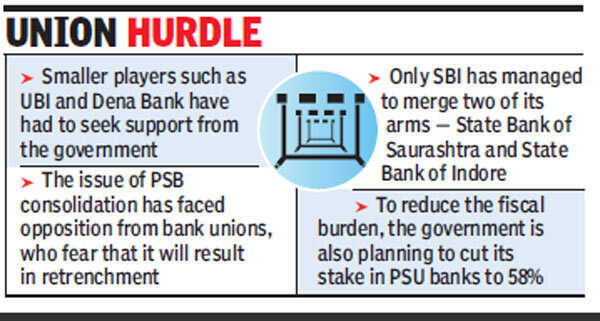
During the closed-door meeting, the sources said, the ministry indicated to bankers that the government may not be able to support them forever as they perpetually need support from the Centre. In recent years, players such as United Bank of India and Dena Bank have had to take some tough decisions, apart from support from the government to tide over difficult times. Despite several attempts, government officials could not be reached for comment.

The focus of deliberations was clearly on the large players as those invited included State Bank of India, Punjab National Bank, Bank of Baroda, Bank of India, Canara Bank, Central Bank, IDBI Bank and Union Bank. Representatives from IFCI and Indian Banks' Association were also there.

While the government had in the past toyed with the idea of consolidation, the issue has never gone past the discussion stage as unions have opposed the move, arguing that it will result in retrenchment. So far, only SBI has managed to merge two of its subsidiaries — State Bank of Saurashtra and State Bank of Indore — but has since pushed the pause button. In the past, discussions had focused on merger of smaller banks with larger players and on considerations of giving the larger entities a bigger footprint in areas where their presence is weak.

Even this time, bankers said there is no concrete proposal on the table. "The government has just floated an idea and that too at the official level. In any case, any progress will depend on the level of political support and there is no statement on it so far," said a bank chief.

The government is looking at ways to reduce its fiscal burden and also asked banks to reduce government stake to up to 58%, arguing that the buoyant mood in the markets may help the Centre fetch a good premium. The government holding in Bank of India, IDBI Bank and Indian Bank is much higher than the informal 58% cap, making them potential cases for stake dilution.

As reported by TOI on Tuesday, the government also asked lenders to encourage promoters of highly leveraged companies to sell equity in the stock markets, which will help them reduce debt and improve financial position.
 
Link Times of India


Bank mergers: Finance Ministry examining various possible options to create
robust financial institutions-Economic Times 05.06.2014


NEW DELHI: The finance ministry is examining various suggestions made by
investment bankers to merge the country's biggest state-run banks to create much
stronger financial institutions.
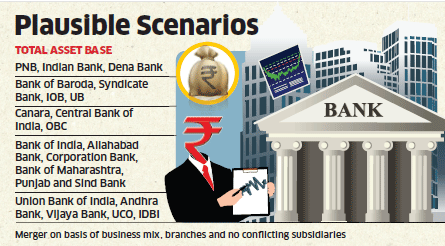
One proposal suggests Punjab National Bank Indian Bank and Dena Bank be merged to create a bank with an asset base of  more than Rs 9 lakh crore. Another possible combination is Bank of India,  Allahabad Bank, Corporation Bank  Bank of Maharashtra and Punjab & Sind Bank

The finance ministry is examining proposals that include consolidation based on
geography, business mix and information technology systems. Both private and
public sector investment banking firms have made proposals, a senior finance
ministry official told ET.

Separately, ET has learnt that at least
three investment banks made suggestions while pitching for mandates. "We are
examining those inputs. The basic framework is to look at creating large banks
with a pan-India presence ," the official said, adding that any merger decision will hinge on political
more than economic considerations. India's banks are still small when compared
with global rivals. The country's largest, State Bank of IndiaBSE 1.48 %, is ranked 16th in Asia while Bank of BarodaBSE 2.45 % is at 32.

According to a report by
Morgan Stanley, there is significant overlap among various state-owned banks in
terms of branches, mode of operation and clients. "Consolidation should enable
state owned bank to extract synergies fairly easily.


But, it also noted that mergers won't be easy given the strength of the unions.
In presentations to the finance ministry, most investment bankers pointed to HR
issues standing in the way of consolidation efforts.

One proposal,
based on business mix and the absence of conflicting subsidiaries, calls for the
merger of Bank of India, Allahabad Bank, Corporation Bank, Bank of Maharashtra
and Punjab & Sind Bank to create an entity with an asset base of more than
Rs 11 lakh cr ..


Read more at:
Link Economic Times

Tuesday, June 3, 2014

Bank Union On Wage Revision

ALL INDIA BANK OFFICERS’ CONFEDERATION
(Registered under the Trade Unions Act 1926, Registration No.:3427/Delhi)
C/o Bank of India, Parliament Street Branch
PTI Building, 4, Parliament Street, New Delhi:110001
Phone:011-23730096 Tel/Fax 23719431
E-Mail: aiboc.sectt@gmail.com
Circular No. 2014/41 Date: 02/06/2014
TO ALL AFFILIATES/MEMBERS
Dear Comrades,
Our members are aware that since approximately last three months Xth Bipartite Settlement talks are at standstill. Though it is mainly on account of election process the country was undergoing, but it is quite natural for the members to get restless on this delay. Soon after taking over of new Government, we have taken up the matter with The IBA requesting them to reinitiate and expedite the process, vide our letter Ref. 2014-32 dt. 30.05.2014. The copies have also been sent to the Hon’ble Finance Minister Mr. Arun Jaitley and The Secretary, DOFS, MOF requesting them to look into the matter and issue appropriate directions. The text of the letter is as follows:
QUOTE:

X th Bipartite Settlement Talks.
100 Day Agenda Set By Hon’ble Prime Minister
One year and seven months have passed since Officers and Workmen Organizations in the Banking Industry submitted their Charter of Demand for 10th Bipartite Settlement. The slow pace with which the negotiations are taking place cannot be appreciated by any one of us, whatever may be the reason. No meeting has taken place on the issue for the last three months. The situation is alarming and causing lot of anxiety and frustration amongst the officers and workmen in the Banking Industry which is bound to affect their productivity and efficiency. 
The growing disparity in the pay structure of the staff of Banking industry vis-a vis the Govt. employees and the apathy shown so far by the earlier Govt., to give a fair deal in the Xth Bipartite Settlement is really agonizing. With the new Government taking over, hopes have been raised as all sectors of the economy have already started looking up. In view of this scenario, the attrition rate in the Banking Industry, which is already starving with the competent and experienced staff, will go further high with opportunities opening out in other sectors. 

Hon’be Prime Minister of India, Sh. Narendra Modi has set out a hundred day agenda for governance. One of the main action points desired in this agenda is improving the delivery by decision making. We request you to kindly take immediate steps and initiatives to initiate the discussions on the Salary Revision, so that we in the Banking Industry also contribute towards the new goal set by our Prime Minister and set an
example of good governance. 

We are confident that this agenda of ours will be written in the golden letters as contribution of the Banking Industry. We once again assure you to rededicate ourselves in extending our full cooperation in achievement of the agenda of social developments set forth by the Government / Bank Managements. 


Thanking you,
Yours sincerely,
Sd/-
(HARVINDER SINGH)
GENERAL SECRETARY
UNQUOTE
Any development in this regard shall be circulated to you all.
With warm greetings,
Yours comradely,
(HARVINDER SINGH)
GENERAL SECRETARY

Friday, May 30, 2014

Good Days For Banks Ahead

Finance Minister Arun Jaitley to first target Rs 2 lakh crore bank NPAs--DNA-30th May 2014

Non-performing assets (NPAs) of banks estimated at over Rs 2 lakh crore seem to be top on finance minister Arun Jaitley's agenda. Jaitley is weighing various options such as shifting the bank NPAs to asset reconstruction companies on a wider scale, and sweeping changes in the Debt Recovery Tribunal's (DRT) legislation, making the dispensation of cases time-bound.
Jaitley, after his meeting with the Department of Financial Services secretary Gurdial Singh Sandhu, also asked officials to expedite the new bank licences and ensure adequate capitalisation of the banks.
Post the meeting, Sandhu said, "Various measures to address the issue have been discussed. The first one being change of management of such NPA companies."
"Secondly, we need to make certain changes in the DRT legislation. Cases need to be dispensed in a time-bound manner. We need to see whether there could be multi-member DRTs," Sandhu said.
The total stressed assets of the public sector banks is Rs 2.09 lakh crore. The All India Bank Employees Association recently announced a list of public sector banks having a total of Rs 70,000 crore of NPAs.
In the meeting, Jaitley asked the mandarins to ensure that the banks remain fully capitalised and to also speed up the procedure for issue new bank licences.
The department of financial services would also create a road map for capitalisation of banks. "Basel III norms need to be adhered to before March 2019. We have to provide them capital. The options of raising money are government funding and the banks exiting from non-core businesses," Sandhu said.
The government is also in the process of forming the guidelines for banking licences.
The idea of differential banks such as bank for payments, wholesale bank for infrastructure funding, retail bank and local area banks is also being considered.
Jaitley also held separate deliberation with revenue secretary Rajiv Takru on goods and services tax. It is believed that Jaitley would call a meeting of the state finance ministers to carry on the stalled talks on the issues concerning GST.
Link DNA


I-T Dept. asked to share wealth details of defaulters with banks-The Hindu 30 May 2014

Information should be used only for recovery of loans’

In a step to help public sector banks to recover bad loans, the Finance Ministry has asked the Income Tax Department to share details of defaulters’ wealth tax returns with public sector banks (PSBs) if they ask for such information.
The Ministry, in a communication to Commissioners of Income Tax, said, “The CBDT ... clarifies that information on assets of loan defaulters to enable recovery of loans by PSBs from such defaulters is in public interest.’’
The top 30 non-performing assets (NPAs) of state-owned banks account for 40.2 per cent of their gross bad loans.
According to available data, NPAs of state-owned banks rose by 28.5 per cent to Rs.2.36 lakh crore in September last from Rs.1.83 lakh crore in March, 2013. It is expected to have grown further.
Reserve Bank of India Governor Raghuram Rajan had recently expressed concerns over the bad loans in banks.
The directions were issued in view of reluctance of the Income Tax Department, which comes under the Central Board of Direct Taxes (CBDT), to share information provided in wealth tax returns with banks despite repeated requests. However, the Finance Ministry said banks would be allowed to recover their dues from sale of assets of defaulters only after settlement of the claims of the tax department.
“In order to ensure that tax dues of the department against the defaulter (if any) are safeguarded, an undertaking be obtained from the PSB to obtain an NOC from jurisdictional CIT of the loan defaulter before appropriation of the surplus amount recovered from sale of immovable/movable asset of the defaulter, information in respect of which is shared, after adjustment of its loan dues,” it said.
The Finance Ministry further said the information provided by the Income Tax Department to banks should only be used for recovery of loans and should not be shared with any other agency.

Operation Clean-up--Hindu Business Line

State-owned banks have shown some progress in shedding NPAs, but they need to do much more
Finally, there seems to be some light at the end of the tunnel for banks weighed down by their large portfolios of non-performing assets (NPAs). Part of this has come about because of the economy bottoming out, leading to a reduction in fresh loan delinquencies. Public sector banks (PSBs) actually saw their total NPAs decline in the January-March quarter, after expanding sequentially by 6-10 per cent in the previous three quarters. Besides, they have started selling some of their bad loans to Asset Reconstruction Companies (ARCs). Such asset sales amounted to around ₹50,000 crore in 2013-14, against ₹12,000 crore in the preceding fiscal.
The ARCs were set up over a decade ago to help banks expedite loan recovery without the intervention of courts. But until last year, this route was hardly used as banks were reluctant to sell their NPA portfolios at the steep discounts demanded by the ARCs. But now the sheer weight of NPA pile-ups has forced banks to negotiate mutually acceptable solutions for selling their bad loans at higher prices in return for deferred payments. While this is welcome, PSBs have also turned more willing to explore other avenues to shed bad loans. This has happened especially since the Reserve Bank of India’s (RBI) diktat on early recognition of doubtful loans — even before the existing 90-day overdue norm for explicit NPA classification — coming into effect this April. The RBI has, moreover, granted banks some accounting leeway to recognise losses from asset sales to ARCs over a two-year period. This has been a big relief to most PSBs, who are yet to provide for half of the bad loans in their books.
But it may still be some time before PSB balance sheets are repaired substantially to enable them to resume large-scale lending, especially to long-gestation infrastructure projects that the current government sees as the key to drive the next investment and growth recovery. For this to happen, judicial interventions that cause delays in the ARC process need to be reduced. This will help both banks as well as the ARCs to quickly unlock value from the borrowers’ assets. Also, before they embark on their next lending cycle, banks need to address the many lacunae in their existing practices. The NPAs that have mounted during this downturn have brought to light PSBs’ flawed approach to consortium lending as well as lack of prudence in increasing exposures to select sectors and business groups. It has also cast doubts over their ability to conduct due diligence on long-term projects and assess the risks that could lead to delinquencies. In this context, reducing direct government control over PSBs, in line with the recommendations of the PJ Nayak committee and bringing in private sector or foreign partners with requisite expertise would improve both their project assessment and risk management systems. This will ensure the next boom will not result in an NPA build-up of the sort we saw at the end of the last one.

Thursday, May 22, 2014

Wage Revision AND NPA

What is the link between ‘Wage 

Revision’ and ‘NPA Reduction’? 

By Sri Pannvalan 


There is a growing clamour that so long as there is a high volume of NPAs in banks, bank staff cannot aspire to get a decent wage revision.  Even many bank staff themselves have started believing this shallow and unfounded logic. I wish to say one thing to all of them.

If it is insisted that the NPA position must be brought down to 'Zero' or near zero level, bankers must demand that the central government employees shall not be paid any salaries at all (leave alone hikes), until and unless -

  1. The central government brings down the current account deficit to 'Zero' (CAD was at Rs.216,000 crores for 2013-14 as per the news item in NDTV Profit on 21-05-2014.
See this link –
http://profit.ndtv.com/news/economy/article-indias-current-account-deficit-may-come-down-to-2-3-per-cent-of-gdp-in-fy15-citi-389022
  1. The central government brings down the fiscal deficit to 'Zero'. (Fiscal deficit was at Rs.519,529 Crores for 2013-14 as per the news item published in various newspapers).
See this link –
http://zeenews.india.com/business/news/finance/indias-cad-expected-to-come-down-to-32-billion-chidambaram_98435.html.
  1. The central government recovers the huge tax arrears due from big industrial houses, large corporate groups, MNCs and high net worth individuals (HNIs), in Income Tax, Service Tax, Customs Duty, Excise Duty, Property Tax etc. in full (Income Tax arrears alone stood at Rs.580,000 crores as at the end of March, 2014).
  1. So far, the central government has passed on various concessions and exemptions from duties and taxes to all major industrial groups in the country and loss/sacrifice arising out of such concessions and exemptions is estimated to be Rs.45 lakh crores during the last 10 years of UPA rule (2004-2014). This is in addition to similar exemptions and concessions extended by various state governments for which no dependable statistical data is available.
  2. Finally, the central government recovers all the losses incurred in Coalgate, 2G Spectrum, Commonwealth Games Scam, Adarsh Housing Scam, Westland Helicopter deal and all other scandals involving trillions of Indian Rupee. 
See these:
http://en.wikipedia.org/wiki/List_of_scandals_in_India#2014).
http://www.thehindu.com/opinion/editorial/behind-the-sband-spectrum-scandal/article1200374.ece
Let us not unnecessarily make ourselves responsible and accountable for big ticket NPAs, because such NPAs were not our creation.  Let us not commit ourselves for recovery of a major portion of outstanding NPAs, as a pre-condition for a decent wage revision. I wish to reiterate here that any such action from our side will only be suicidal and it will be a great disservice to the entire banking community. I request everyone to shed this thought forthwith.  Let us not fall into the trap laid by our adversaries at this moment.
I very strongly condemn the mischievous elements amongst us, with firm conviction and full force at my command.


Date: 21-05-2014                                                                                                                  pannvalan

Bank Interest Should Be Tax Free-Why?

Why bank depositors deserve tax-free interest-MoneyLife
Bank depositors suffer from poor service and problems of getting TDS certificates on time, whereas a tiny part of the population enjoys tax-free dividends and capital gains from stocks. Here is a suggestion to make it fairer for bank depositors
The bank depositors are the pillars of strength for the commercial banks, but they are the most harassed, most repressed and deprived. They don’t get the service they have a right to expect, they don’t get the right product they need, they don’t get the right price for their deposits and they don’t get the respect they deserve for the deposit support they provide, which is the basic raw material for banks to make profits. 
The worst part of banking is the negative return they provide to the depositors, who in the interest of safety of their hard earned savings place implicit faith in the banks and silently suffer erosion in their savings without realizing the loss they incur year after year. The high rate of inflation and the rising cost of living have created a deep dent on their savings. This is made worse by tax laws, which are regressive on account of the failure of the government to bring inflation under control. 
As against these inflation figures, interest rates on deposits during the above period ranged from 8.00 to 8.50 % per annum for one year deposits, which is lower than the inflation, which means it is a negative real rate of return for the depositors. There are about 500 million people in this country with bank accounts and at least half of these account holders may have term deposits in some form or other. Inflation is a hidden tax on such a vast number of people, who bear this burden without even realizing it till it bites them severely. The most awful part is that people have to shell out income tax on the interest earned on bank deposits at the rate ranging from 10% to 30% depending upon the total taxable income of each individual. This virtually results in double taxation on poor and middle class people, who form the majority of honest tax payers in our country. 
As a result it is driving the common man to invest in unreliable ponzi and money-multiplier schemes, which are thriving at the cost of the not-so-financially-literate middle class and lower middle class, who together constitute about half the country's population. 
As if this agony is not enough, all these bank depositors who honestly pay taxes on the interest received from banks on their deposits, have been suffering in silence for the past several years, because, day by day, they find it difficult to get TDS certificates from these banks, who simply do not bother to give the certificates on time. In the month of July every year, people have to run from pillar to post to get TDS certificates from their banks, to enable them to file their tax returns on time. 
The paradox of earned and unearned income:
India is a tax haven for the rich as they do not have to pay any tax on their investment income, because the dividend income is totally tax free at the hands of the shareholders and capital gains on stock market investments are either tax free or taxed at lower rate of taxes. As per the press reports the aggregate dividends earned by business houses during 2010-11 was Rs48,191 crore on which no tax was required to be paid. The Tata group dominated the business houses and its 29 group companies together paid Rs3845 crore as dividend to the holding company, on which holding company did not have to pay any tax.
Here is a list of top ten individuals whose dividend income runs in to crores of rupees, which are totally tax free under the existing laws in India. 
It is ironical that a common man in India has to pay income tax if his/her total income including interest on bank accounts crosses the basic exemption limit of Rs2,00,000 per year, that is just a paltry sum of Rs16,660/- per month, which is  inadequate even for a small family to make a bare subsistence living. And if he places his hard earned savings in fixed deposit with banks, income tax gets deducted at source from the interest received on these deposits, even before he receives any interest from the bank. 
Citizens who depend on bank interest: 
Bottom of FormThe anguish and anxiety of bank depositors who almost wholly depend on the interest received from banks for their livelihood, is only to be experienced to be believed. To save themselves from the burden of TDS, they are required to submit form 15G or15H to the banks concerned, at the beginning of every year, if their total income for the year is within the exempted limit prescribed under the Income-Tax Act. And this form is required to be submitted every time they make a fresh deposit with the bank, which is both wasteful and cumbersome. 
The common experience of many of the citizens has been that such forms submitted by them many times, either gets misplaced at the bank's branches or are not properly noted in bank's records, due to which tax gets deducted at source, forcing them to undergo the rigmarole of filing income-tax returns to claim refund of tax that has been wrongly deducted, as banks refuse to refund such wrong deductions.
These are the woes of bank depositors in India who receive a raw deal from the commercial banks because they do not have anybody to champion their cause. The government is keen to expand the reach of banks in unbanked areas propagating financial inclusion, but has done precious little to incentivise savings through the banking system. 
There is an urgent need, therefore, to find a lasting solution to this double whammy faced by the hapless depositors, who form the backbone of the country's banking system. The only plausible solution to free millions of our country men and women from this agony and suffering caused by the irritating provisions of the tax laws and the complex systems of compliance is to make the interest paid by the commercial banks on all their deposit accounts tax-free at the hands of the recipients. And this can be achieved without hurting government coffers, if the following suggestion is implemented by the Finance Minister in right earnest. 
In the Finance Act 2003, the then finance minister announced a bonanza for corporate investors. By a stroke of the pen, he abolished income-tax on dividends declared by domestic companies and approved mutual funds, and made it totally tax-free in the hands of shareholders and mutual fund investors from 1 April 2003. This was a great boon to the investors in the stock market, who unfortunately form a microscopic minority in our country. This step mainly helped corporate bigwigs, the high and the mighty, the rich and the wealthy and high net-worth individuals, who have invested in the stock market and reaped the rewards of tax-free income. Now, there is no TDS, no income-tax and no harassment of investors in the stock market. 
In order to compensate the government for the loss of revenue caused by this tax-free dividend, the finance minister introduced simultaneously the dividend distribution tax, to be paid by companies paying dividends to their shareholders. This move worked to the advantage of the government, who got taxes paid in the beginning of the year directly from the companies, when the dividends are declared, instead of collecting in piecemeal from the shareholders throughout the year. 
Subsequently, the government totally abolished income tax on long term capital gains earned on stock market investments held for more than one year and in its place introduced securities transaction tax at nominal rate for all stock market transactions done through the recognized stock exchanges. 
While these steps no doubt benefited the rich and the high net worth individuals, it touched only a fringe of the population. It would be only fair to extend the same principle to millions of individuals (not businesses or corporates) covering the middle and the lower middle class by declaring the interest received from the scheduled commercial banks upto a certain level free of income-tax at the hands of the recipients, thereby providing much-needed relief to the large body of bank customers and depositors, who have been at the receiving end of the blow caused by rising inflation and poor customer service provided by the banks. This is nothing new considering that all non-resident and foreign currency deposits held by NRIs are already tax-free at present and it is only the extension of such a provision to domestic deposits as well, which will put resident Indians at par with non-residents. 
How to recoup the loss of revenue to the exchequer?
In order to bridge the budgetary deficit that might be caused by this step of freeing bank deposits from income-tax, the finance minister can consider levying interest payment tax on commercial banks at a very nominal rate, to be paid by banks along with the advance income-tax remitted by them every quarter. This interest payment tax, based on the total interest outgo of each bank, on the lines of the dividend distribution tax but at a fraction of this rate, will be the best substitute for the tax presently levied on each deposit kept with the banks. This extra burden on banks can be easily absorbed by them as this will help the banks to considerably improve their deposit base due to tax-free benefits available on bank deposits and will help them to increase profitability too, by substantially increasing their lending operations.
The benefits of this exercise for the people, the government and the banks, when implemented, can be summarised as under: 
  1. The biggest relief will be for the common man who has been suffering from the burden of high inflation and poor customer service from banking institutions. 
  2. The economy will get a boost as the savings rate will shoot up considerably due to bank deposits becoming an attractive investment destination for the common man who will not fall a prey to ponzi schemes and the like. 
  3. The financial inclusion programme of the RBI will get a shot in the arm as banking will be hassle-free, tax-free and free from the complexities of taxation laws for all those who are brought into the banking system.
  4. The banks in the country will be the biggest beneficiaries with bank deposits becoming the most attractive investment avenue for the public, and banks would be flooded with deposits, which through judicious lending will improve their profitability considerably. 
  5. Due to the tax-free status of bank deposits, people in rural areas will be attracted to banks to invest their surplus funds, thereby serving the cause of rural population admirably and banks will be keen to open more branches in rural areas, which will benefit both the banks and the rural people. 
  6. There are more than 1,10,000 branches of banks in India today and they will be saved from the burden of deducting taxes every now and then and filing innumerable returns to several authorities, thereby saving time, energy and money for the banks in the country. 
  7. The government, in turn, will benefit from getting taxes directly from banks in one go, helping the government treasury with better cash flow and improved management of funds. 
  8. The income tax department will be saved the burden of processing millions of small value tax returns and dispensing refunds thereby, saving on cost of operations and improving efficiency.
If this proposal is implemented on the lines suggested above, this will be one of the most people-friendly measures from any government in power and will go a long way to earn the trust and confidence of millions of people without any loss of revenue to the government. This is the best way in which the new central government in the country can create a new paradigm shift in the banking industry and serve to meet the expectations of over a billion people of this country, who are waiting for economic revival with social justice. 
(The author is a banking analyst and he writes for Moneylife under the pen name 'Gurpur'.) 

Thursday, May 15, 2014

Privatisation of PS Banks or Merger Of banks

Privatize PSU banks, change governance structure: RBI panel--Live Mint

The panel suggests the govt should either privatize or merge banks it owns, or design a radically new governance structure to allow these banks to compete successfully
By Anup Roy & Dinesh Unnikrishnan ( My views given below)
Mumbai: A Reserve Bank of India (RBI) panel set up to review governance of bank boards has suggested that the government should either privatize or merge state-run banks, or design a new governance structure for these banks to allow them to compete better and avoid repeated requests for recapitalization.
The panel suggested privatization or a different governance structure in view of the low productivity and steep erosion in asset quality and “demonstrated uncompetitiveness of public sector banks over varying time periods”.
The panel, headed by former Axis Bank Ltd chairman and Morgan Stanley India head P.J. Nayak, has also suggested significant changes in the shareholding pattern  of banks.
The panel suggested that the RBI should designate a specific category of investors in banks known as authorized bank investors (ABI), who would be allowed to hold as much as 20% in banks without regulatory approval. Such investors would include funds with diversified investors.
“ABIs would therefore include pension funds, provident funds, long-only mutual funds, long-short hedge funds, exchange-traded funds and private equity funds (including sovereign wealth funds) provided they are diversified, discretionally managed and found to be ‘fit and proper’,” the panel said, adding that the investor would be allowed to hold 20% provided that it does not possess the right to appoint a board director.
An ABI with a board representation should get 15% investment limit without regulatory approval. “Every other investor should be permitted no more than 10% without regulatory approval,” the panel said.
Currently, a single investor is allowed to hold only 5% stake in a bank without regulatory approval.
Abizer Diwanji, head of financial services at EY, said the suggestions are “impractical”.
“This is a large judgmental issue on letting a group of investors, with significant stake, be made fit-and proper after having the stake and not before it. This can never happen,” said Diwanji, referring to the committee’s suggestion that the fit-and-proper status of an investor need not be judged prior to investment.
The Nayak panel also recommends that if a bank is identified as “distressed”, private equity and sovereign wealth funds should be permitted to take a controlling stake of up to 40%.
Nayak panel’s recommendations come against the backdrop of rising bad loans in the banking sector, particularly on the books of state-controlled banks.
Till December, 40 listed Indian banks have gross non-performing assets (NPAs) of Rs.2.43 trillion, up 36%, from previous year. Of this, about Rs.2.19 trillion are with state-run banks. Besides the bad loans, an estimated Rs.5-6 trillion loans are being restructured in the banking system. Under existing norms, banks need to set aside up to 100% of the loan value if a loan turns fully bad and 5% of the loan value if restructured.
Rising bad loans have meant that banks need more capital to set aside as provisions, in addition to the higher capital requirements under advanced basel-III norms. According to RBI estimates, Indian banking system would require Rs.8 trillion of capital to sustain a loan growth of 20%. The government is struggling to meet these capital requirement for state-owned banks, in which it is the majority owner.
In the case of public sector banks, the RBI committee suggests that a bank investment company (BIC) be set up to hold equity stakes in banks which are presently held by government.
The autonomy of BIC should be ensured and the CEO of BIC should be a professional banker, the committee said, adding that the government should stop giving any regulatory instructions to banks applicable only to PSU banks as dual instructions are discriminatory.
The government should also consider reducing its holding in banks to less than 50% to enable a level-playing field for public sector banks in matters of vigilance enforcement, employee compensation and the applicability of the right to information.
“If such incentivisation requires the government to hold less than 50% of equity in BIC, the government should consider doing so, as it will be the prime financial beneficiary of BIC’s success,” the panel said.
Privatization will improve the governance standards in banks, said Shinjini Kumar, director (banking regulations) at audit firm PricewaterhouseCoopers Pvt. Ltd.
“The current deterioration in the operations and asset quality of public sector banks would mean that the government is constantly feeding the PSBs but not getting the returns. If you have shareholders with significant stake involved at the board level, this can help to improve the governance standards of banks,” Kumar said.
However, some of these suggestions may be difficult to implement.
“The government will never let its stake go down below 50%. Besides, there are various stakeholders like unions, employees etc. These recommendations will never be acceptable,” said Diwanji.
According to the RBI panel, constraints like dual regulation of public sector banks— by the finance ministry and RBI, short appointment tenure of the leadership in banks, low compensation, vigilance enforcement and applicability of the Right to Information Act, should be rapidly eliminated or significantly reduced in order to avoid erosion of competitiveness of state owned banks.
In addition the committee recommended a minimum five-year tenure for bank chairmen and a minimum three year tenure for executive directors.
Separately, the RBI panel proposed that the ownership ceiling for promoter investors be raised to 25%. Presently the promoters are required to bring down their stake over time to a maximum of 5%. The panel added that it is not for the RBI to stipulate a time limit for a new bank to list in bourses “as premature listing could be injurious to minority shareholder interests”.
The RBI should also raise the voting rights limit to 26% in banks to align it with Companies Act, the committee suggests.
Link LiveMint


My comments are as follows:

Banks were nationalized in the year 1969 with a sole purpose of extending banking services and loan facilities to poor villagers, farmers, small industrialists and traders who were not getting adequate support from the then set of private banks. Local money lenders used to exploit poor people when they used to approach for finance.

 Smt Indira Gandhi took the bold step of converting private banks into public sector banks so that social welfare motive of the Constitution enshrined in Directive principles could be achieved. If government of India decides to earn profit only by banks, then they should not cry for social welfare schemes, or financial inclusion or equitable growth of all sectors for all sections of people in country.

In a country like India where 90 percent of population are poor and where unemployment problem has become the most painful and dangerous problem of the country, India cannot afford to handover the banking sector to private sector and thus again force the common men to dance and die  as per dictates of promoters of these banks. 

Here it is important to mention that despite full freedom given to public sector banks and new private banks after launch of 1991 reformation era, these banks did not participate whole-heartedly and sincerely to social welfare scheme launched by the government during last two decades and did not extend desirable finance to poor people. Private Banks specially did not participate at all in financial inclusion and neither in poverty alleviation schemes.

Obviously All these banks Private as well as public sector banks during last two decades exerted all their mind and energy to earn more and more profit by bulk lending and by ignoring small traders, small farmers and small scale industrialists. Though private banks earned profit and grew by leaps and bounds in earning profit and in raising business during last two decades , public sector banks neither could protect their assets and nor could earn desirable profit.

As a result of this hunt for profit, public sector banks started competing with private banks without preparing necessary ground for it and without keeping in view the mindset of bank employees as well as politicians. They had to face ministers and politicians also not only to serve social objective but also to serve self interest of politicians.

Management of these banks could not reform Human Resource who are supposed to be backbone for healthy growth but they took unwise initiative and bold step to indulge in bulk lending to book highest profit in shortest period. They fully lacked in knowledge, skill and monitoring and they did not get legal support in recovery of loans from defaulters. Due to this, banks failed to keep banks assets in standard category.

As a consequence of this mismatch in mindset of public servants vis-a-vis private bankers and due to their blind and dreadful effort to compete their private counterparts, PS banks failed to serve not only social motive of nationalization but also miserably failed to protect the health of assets of the banks. Such mismanagement of assets created out of mismanagement of Human Resource jeopardized the interest of small depositors, small investors and small borrowers who reposed faith in banks because most of public sector banks are now sick of bad debts. Majority of PS banks are facing profit erosion and capital erosion.

As such it is not the issue of who are in the board or what the share of government in bank’s capital is. It is the question of quality, honesty, sincerity and integrity of workers and managers of these banks. It is the question of mindset of corrupt politicians who are ruling this country. It is rulers who can make or mar the basics of this country.

Not only banks, even judiciary, police system and administrative machinery all have become inactive, ineffective and corrupt only due to political intervention and political exploitation, and not due to faulty constitution of controlling body or board . 

If privatization is the panacea and solution to all problems , then Government should first handover the administration to private sector and slowly and gradually judiciary, police , CBI and other crucial regulating set up should also be handed over to private sector .
As such only privatization of banks may not prove to be fruitful unless and until administration machinery, judiciary and all other government departments are under the control of corrupt politicians. 

It is therefore ridiculous to imagine that banks can serve the desired purpose with safety and security of all merely by diluting government stake or by changing the rule for constitution of boards. Even if smaller banks are merged to make stronger big bank, the problem will not end as it has not ended in BSNL or in Air India or in Indian Railways.